
There is a version of AI tooling that optimizes for impressiveness. It runs autonomously, executes without pause, and produces output at speed. It looks remarkable in a demo. In a production codebase, it can cause real harm.
Dropstone IDE was not built around that version.
It was built around a simpler, more honest premise: AI models today — including the most capable ones, the ones that score highest on the benchmarks people cite in product announcements — still make mistakes. Not rarely. Regularly. And in software development, a mistake that goes unreviewed is not a minor inconvenience. It compounds.
The CLI Question
Early in Dropstone's development, the team evaluated whether a CLI-first approach to AI integration made sense. The research came back unambiguous. CLI-driven AI workflows, while elegant in theory, are incomprehensive in practice for serious software work. Context is opaque. Execution is hard to follow. There is no visual layer between the developer and the AI's output. The overhead this introduces — cognitive, operational, and in terms of error recovery — is not a cost that responsible engineering teams should absorb quietly.
The IDE exists for a reason. It was designed, from its origins, to increase developer productivity by giving developers visibility into their work. Adding AI to that environment doesn't change the fundamental contract. It extends it.
Expecting Failure Is Not Pessimism
One of the more important things a team building AI tooling can do is resist the temptation to oversell what the underlying models can do. Plasticity and stability in AI-generated code remain genuinely unsolved problems. A model can perform exceptionally on standard evaluations and still produce subtly incorrect logic when placed inside a specific codebase, with specific dependencies, against a specific set of requirements.
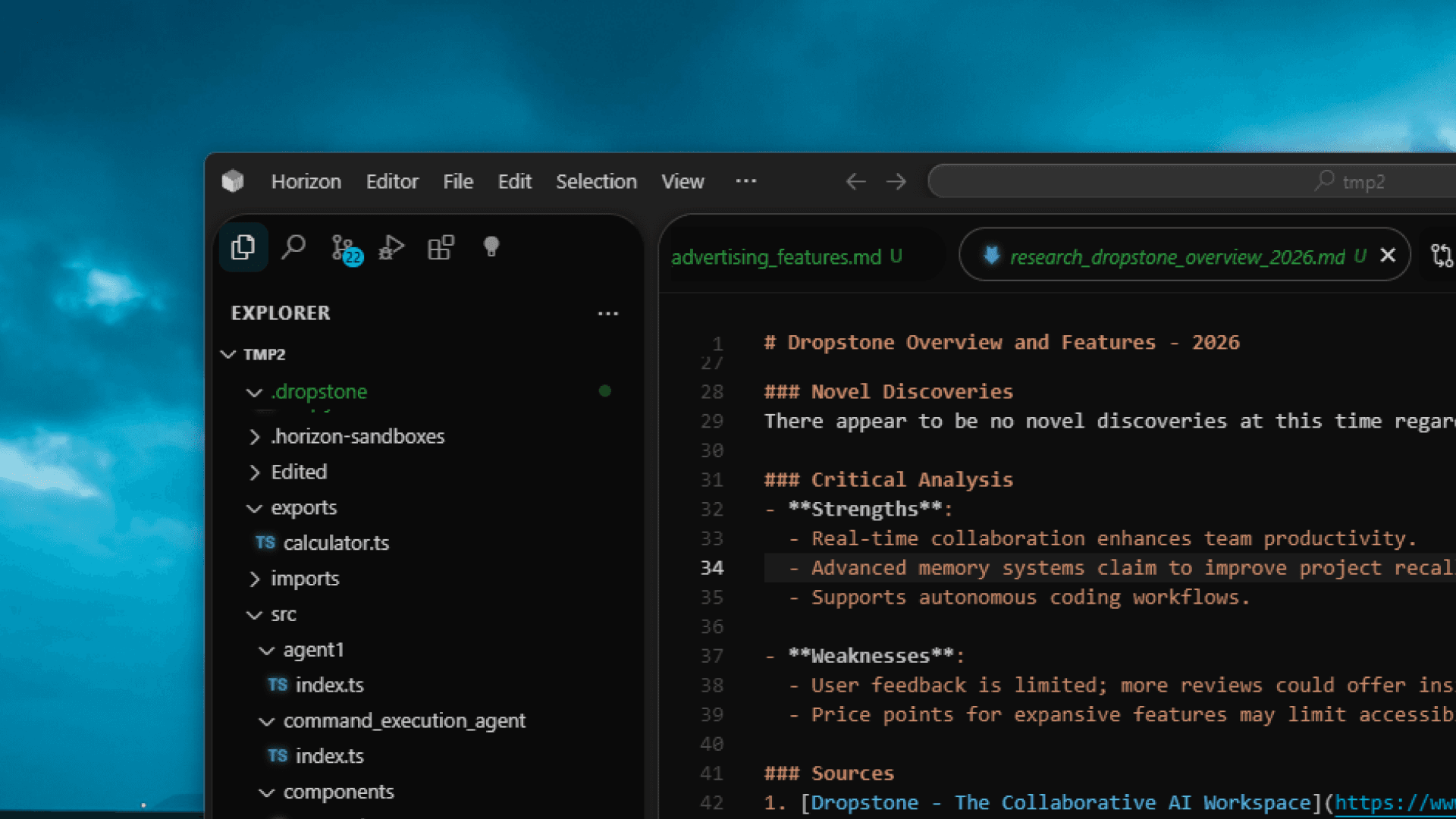
Dropstone was designed with this in mind. The editor view is the primary interface not as a stylistic choice, but as a structural one. The developer sees every change. Checkpoints are built into the workflow — not as friction, but as the mechanism by which developer judgment stays inside the loop. The AI proposes. The developer decides.
This is not a limitation of the product. It is the product.
What Guidance Actually Means
There is a difference between an AI that acts and an AI that acts with the developer's understanding. Dropstone is oriented toward the latter. Developer insight — the ability to see what the AI is doing, why it is doing it, and what the consequences are before they are committed — is treated as a first-class feature of the environment, not an afterthought.
This matters across the full software engineering lifecycle. In planning, the developer shapes the AI's direction. In implementation, checkpoints preserve review. In debugging, the editor surface makes changes legible. In iteration, the developer's corrections become the signal that improves future output.
The goal is not to remove the developer from the loop. The goal is to make the developer's presence in that loop as productive as possible.
On Benchmarks and Reality
It is worth being direct about something the industry is sometimes reluctant to say: benchmark performance is not the same as reliable production behavior. Models that score well on coding evaluations can and do produce incorrect, unstable, or contextually inappropriate code in real engineering environments. This is expected. It reflects genuine open problems in the field — in how models generalize, how they handle ambiguity, and how they reason about large, stateful systems.
Acknowledging this is not a reason to avoid building AI-powered development tools. It is a reason to build them carefully — with appropriate checkpoints, appropriate human oversight, and appropriate honesty with the developers who use them about what the AI can and cannot yet be trusted to do alone.
A Tool Built for the Engineer
Dropstone IDE is not a bet that AI will stay limited. It is a recognition that, right now, the most productive configuration places a capable AI model alongside a capable developer — not in front of them, and not running unsupervised behind them.
The editor is the main screen. The developer remains the most important part of the loop. And the honest acknowledgment that failures will occur, and must be catchable, is not a weakness in the design.
It is the design.
Dropstone IDE is built for production software development — with developer insight, structured checkpoints, and an honest account of where AI-assisted development stands today.